FEATURED PROJECT | CASE STUDY
Oral Dysbiosis: From Scientific Literature to MSc Lecture
POSTGRADUATE LECTURE | EVIDENCE SYNTHESIS | SCIENTIFIC COMMUNICATION | PRESENTATION DESIGN
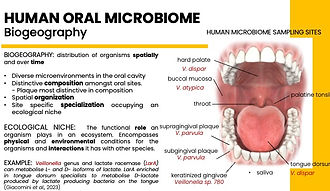
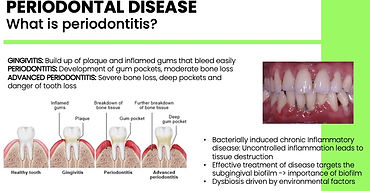
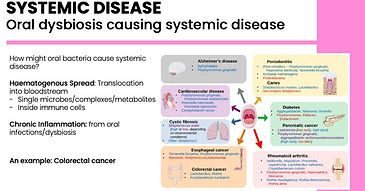
THE PROCESS
RESEARCH : SYNTHESISE EVIDENCE : STRUCTURE : WRITE : VISUALISE
THE AIM
To develop an MSc-level lecture on Clinical Aspects of Oral Dysbiosis that could support both live teaching and continued learning. The challenge was to synthesise a broad body of microbiome research into a coherent teaching resource, balancing fundamental concepts, postgraduate-level scientific detail, current evidence and critical thinking.
MY APPROACH
I approached the project as a process of research, evidence synthesis and scientific communication, to collectively meet the defined learning objectives.
1. Define the learning objectives
I began by defining what I wanted students to understand by the end of this specific lecture. This included establishing a clear definition of oral dysbiosis, before using dental caries and periodontal disease as the two main clinical examples. For each, I wanted students to understand the disease itself, the role of dental plaque, and what research tells us about changes in microbial community composition during dysbiosis.
I also wanted to extend the lecture beyond local oral disease by introducing the potential systemic consequences of oral dysbiosis. I used research into the oral microbiome and colorectal cancer, an area connected to my own personal research project, to explore how this field has developed. I also used this example to encourage students to think critically about association versus causation, and the research approach needed to distinguish between them. This also reinforced a broader theme running throughout the Microbiome in Health and Disease MSc module
2. Research the literature
I then reviewed the literature to identify the key concepts and evidence that would underpin the lecture. This included the ecological plaque hypothesis and keystone pathogen hypothesis, alongside key studies and more recent advances describing changes in microbial community composition in dental caries and periodontal disease.
For the colorectal cancer section, although this was an area I was already familiar with through my own research, I returned to the literature rather than relying on existing knowledge or assumptions. This allowed me to check the evidence supporting the story I wanted to tell and identify more recent developments that should be incorporated into the lecture.
3. Synthesise the science and develop the narrative
I then synthesised the literature into the essential mechanisms, evidence and take-home messages, deciding what information was most relevant to the learning objectives and what could be left out.
I structured the lecture as a logical progression from the healthy oral microbiome and microbial homeostasis, through ecological disruption and dysbiosis, to local and systemic disease. I mapped this narrative into a contents page and sequence of slide titles, using the learning objectives as a framework to ensure each section contributed to the overall flow of the scientific story.
4. Communicate and design the final lecture
I then combined science communication and visual design to build the final lecture. Key definitions were retained in full where precision was important, while findings from the literature were distilled into concise take-home messages, supported by examples and original diagrams and scientific illustrations where these could communicate complex concepts more effectively than text.
I used a clear visual hierarchy to distinguish core learning points from supporting detail, with bold, distinct colours separating the major sections and reinforcing the progression of the lecture. Diagrams and visual summaries were used throughout to condense complex information into more digestible formats, supporting both live teaching and later revision.
All scientific evidence was clearly referenced, including figures adapted or reproduced from published research, with full references provided at the end so students could return to the primary literature and explore individual topics in greater depth.